Kamis, 03 Maret 2011

Recalling the pain of forced adoption

by Clare O'Dea, swissinfo.ch

They came for her one day in the café where she worked – two policemen and a woman from the authorities. “It’s a nice day,” they said, “we’re going for a drive”.

For the next 16 months Michèle Gillard would be in “administrative care”, her rights as a free citizen temporarily suspended.

Until 1981, young people who stepped out of line could be deprived of their freedom without trial or any means of appeal. A recommendation from the guardianship authorities was often enough to seal their fate.

On the grounds of “depraved lifestyle”, “licentiousness” or “alcoholism”, victims were often placed in prisons alongside genuine criminal offenders. Others ended up in residential institutions. The Swiss justice minister apologised last year to all those imprisoned under this legal provision.

National figures have not yet been compiled as the legal procedure was implemented independently by each canton but Bern, for example, recorded 2,700 cases in the four decades the law was in place.

Many cases involved young girls who got pregnant, were then shunned by their families and ended up being forced to give up their babies for adoption.

Confinement

So it was in the winter of 1970 for 21-year-old Gillard. She cried all the way on the drive from Delémont in French-speaking western Switzerland to the “social home” in Walzenhausen in the German-speaking east.

“It was terrifying, arriving in this building in a forest and seeing the girls’  faces, like a horror film. ‘How long are you in for?’, they asked me but I had no idea, all I could do was cry.”

The home in canton St Gallen was notorious among interned girls as a stepping stone to the country’s main women’s prison, Hindelbank in Bern, according to Gina Rubeli-Eigenmann of the victims support group Administrativ Versorgte 1942-1981.

“For  the slightest thing that happened in Walzenhausen, you would end up in Hindelbank and many mothers signed adoption papers under fear of being transferred there,” explained Rubeli-Eigenmann, who herself spent time at Hindelbank under the same “administrative care” legal provision.

For the remaining months of her pregnancy Gillard walked to work every day at a nearby factory in Wolfhalden where she embroidered handkerchiefs. She was not entitled to keep her earnings. In the evenings the girls watched correctional films or knitted.

Unhappy memories

It was not the first time that Gillard had lived in an institution. After her parents’ marriage broke up, she was sent to an orphanage in Epagny, Fribourg run by the Roman Catholic Sisters of Ingenbohl.

In December 2010, the Sisters appointed a committee of outside experts to investigate allegations of abuse and cruelty in the past in the homes and schools run by the order.

Gillard lived in the orphanage in Epagny from the age of six to 13, a time of brutality, hunger and terror, as she remembers it.

There followed an unhappy period when Gillard and her younger sister tried to live with their father and his new wife. Her sister managed to challenge her father’s status as guardian in court and went to live with another family.

At 19, Gillard found lodgings with an old woman in Delémont and started work in a café. She began to enjoy a life of relative freedom after the restrictions and privations of her childhood. It wasn’t to last.

" Phone calls forbidden, visits forbidden, I had no-one. "
Michèle Gillard

“Naive”

“I was having a good time, going out and meeting boyfriends. But I was ignorant, I was naive, I think I was stupid really. We had been told nothing. The only education I received was the ABC.”

On a night out with her brother, with whom she had been temporarily reunited, Gillard was not able to gain access to the house where she was staying, because she says, she had forgotten her key and the landlady was deaf.

So she and her brother decided to sleep outside nearby, only to be picked up by the police. In the conservative society of the time, far from being dismissed as a harmless teenage prank, this incident earned Gillard a charge of vagrancy and put her on the radar of the local authorities.

By the time she fell pregnant, wheels were already in motion to have her sent away to an institution.

Her family, such as it was, was not prepared or able to help. The father of the child, although he said he wanted to support her, was threatened with being cut off by his family and kept his distance.

And so it was that Gillard found herself in the summer of 1971 on the other side of the country in a maternity clinic cut off from anyone she knew.

“Phone calls forbidden, visits forbidden, I had no-one.”

" I was sent back to work and I only saw her for a half an hour per day "
Michèle Gillard

Kindness of strangers

Gillard breaks down as she remembers the kindness of one midwife who asked other nurses to sit with her during visiting hours and brought presents.

“I stayed a few days there and then they came to collect me. I thought everything was fine but afterwards they put my daughter in a different section, I was sent back to work and I only saw her for a half an hour per day.”

Five months later Gillard’s father and step-mother, with the full support of the authorities, wanted to take custody of the baby girl and Gillard was unable to stop them.

After being released from Walzenhausen, she was barred from their home but refused to sign the adoption papers for years until she eventually gave in when the child was aged seven.

Shame

Deprived of her first child, Gillard felt great shame and unhappiness in the years that followed.

She had another child several years later while living independently who was also taken for adoption, after the authorities threatened to withdraw her social security payments. Taken, not given, she says.

Gillard did manage to meet with her two biological daughters when they reached adulthood but she said the gulf was too great to build proper relationships with them.

Now aged 62, Gillard lives with her husband in modest circumstances and does not talk about her past with friends and acquaintances. Out of shame and fear, she explains. Shame for herself after a lifetime of being judged and mistreated, fear of not being believed; of being thought a liar.

Clare O'Dea, swissinfo.ch

Adoption based on thoughts of “natural law” and is “anthropological,”


.- The Bishops’ Conference of Colombia is calling on the country’s Constitutional Court to reject arguments in favor of the adoption of children by same-sex couples.

The bishops stressed that the rights of children should be placed above “the affective and emotional needs of same-sex couples.”

The bishops’ call came after the Constitutional Court announced Feb. 23 that it would hear arguments on whether to grant custody of a young girl to her mother and her lesbian partner. The child was conceived through artificial insemination.

The Constitutional Court will issue a final ruling on the case after two lower courts ruled that the adoption should take place.

The secretary general and spokesman of the bishops’ conference, Bishop Juan Vicente Cordoba spoke with CNA on Feb. 25, noting that adoption is a “juridical mechanism” the state of Colombia employs to place a child in a two-parent home made up of a mother and father.

This is meant to “replace what was lost, namely, the child’s biological mother and father, and the child is given a substitute mother and father so he can have a new home,” the bishop said.
Such a process is founded upon “natural law” and is “anthropological,” he explained. “It has nothing to do with faith.”

Bishop Cordoba noted that a poll was carried out recently showing that “82 percent of Colombians do not support the adoption of children by same-sex couples.”

“We told the court not to rule based on the ideas of five or six of its members, but rather on those of 45 million Colombians, of whom 82 percent do not want gay adoption,” he said.
“Five people cannot decide for 45 million,” the bishop explained, adding that the bishops have asked the court “to take into account the will of the Colombian people in its ruling.”
Bishop Cordoba, noting the psychological aspect of the issue, pointed out that children raised by same-sex parents “face great difficulties.” 

“Some may grow up to be healthy but many grow up to become homosexuals, bisexuals or they will have identity problems that will affect their ability to sustain a relationship.”

Bishop Cordoba also rejected the statements by some that a child adopted by a same-sex couple would be denied the sacrament of Baptism. “The Church is universal and welcomes everyone,” he said. “The child is not at fault, and if they bring him to the Church to be baptized, the Church will baptize him. 
“He will be joyfully accepted in the Catholic Church,” the bishop concluded.

Right of Information for Adoptees start with Medical Files ?

Adam Pertman

Adam Pertman


News flash: Michelle Obama didn't invent the crusade to improve Americans' well-being. Her focus (as we all know) is childhood obesity but, for the last several years, the office of the U.S. Surgeon General has been waging an even farther-reaching, get-everyone-healthy campaign that centers on this website.
Essentially, citing the obvious fact that many diseases are inherited, the top health official in our country is encouraging all American families to keep abreast of their medical histories, not only in the past but in an ongoing way. And, to make this important task easier to accomplish, the surgeon general's site includes software that everyone can download at no cost to help track medical information about our parents, grandparents and other relatives.

For tens of millions of people, however, this well-intentioned initiative is nothing more than a mirage, an enticing glimpse of water in the desert that they know they cannot reach. Because all of the Americans whom this campaign targets do not in fact include the vast majority of those who were adopted, rather than born, into their families.
Adoption in the United States has made enormous strides in the last few decades, moving out of the shadows and becoming an increasingly conventional, normal way of forming a family; that's especially good news for children who need permanent, loving homes.

But progress has been uneven. One way in which adoption has not yet entered the 21st Century is the anachronistic reality that most states still prohibit adoptees, even after they reach adulthood, from obtaining their birth certificates or other documents that would enable them to follow the Surgeon General's sage advice.
Proponents of keeping these records sealed assert that it's a necessary measure to maintain the anonymity that was guaranteed to birth mothers at the time their children were placed for adoption. That argument, unfortunately, is based on cultural myths and faulty stereotypes.

In fact, nearly every shred of research and experience over the last few decades shows that none of these women were given legal assurance of anonymity; at least 90 percent of them want some level of contact with or knowledge about the lives they created, regardless of what they might or might not have been told verbally; and adopted people are not stalkers or ingrates, but simply human beings who want the most basic information about themselves.
The good news is that we have learned an enormous amount about adoption and its participants as the institution has steadily moved into the mainstream, and many positive changes are occurring as a result. Among them are that parents adopting domestically, and an increasing number who adopt from abroad, routinely receive medical information about their sons and daughters at the outset and -- because relationships with birth families are becoming increasingly commonplace -- on an ongoing basis as their children grow up. Indeed, providing such information is now a widely accepted "best practice" for adoption practitioners.

Some states have changed their laws to permit adopted people, once they become adults, to gain access to their records. And there has been no hint, anywhere, that the recipients of those records are violating their birth mothers' privacy or otherwise disrupting their lives.

States from coast to coast -- from New York and New Jersey to Indiana and Hawaii -- today, right now, are considering legislation that would enable adult adoptees to comply with the Surgeon General's potentially life-saving advice. And next Thursday, March 10, the Evan B. Donaldson Adoption Institute is holding a unique event on this subject at the Hard Rock Café in Manhattan; for more information, go to www.adoptioninstitute.org.
With all that activity on the ground, it's a propitious time for U.S. health officials at the top, starting with the Surgeon General, to use their influence to break down the legal barriers across our country that for far too long have relegated adoptees to a special, less-privileged class of citizenship.

There's good reason for them to do it. After all, their medical advice is supposed to apply to all Americans.

Sabtu, 26 Februari 2011

See the reality behind the Eyes of Adopted Children from Haiti


Nach dem Erdbeben in Haiti vor einem Jahr gab es einen Skandal um die Adoption haitianischer Kinder: Verschiedene Organisationen, darunter US-Missionare, hatten vermeintliche Waisen aus dem Land bringen wollen, obwohl sie Eltern hatten. Wir zeigen Bilder von haitianischen Waisenkindern, die bereits vor dem Erdbeben adoptiert worden waren. Erst Ende 2010 wurden diese Kinder von ihren Adoptiveltern nach Frankreich geholt. Das Chaos nach dem Beben und die Cholera hatten das Verfahren verzögert


After the earthquake in Haiti a year ago there was a scandal surrounding the adoption of Haitian children: Various organizations, including U.S. missionaries, alleged orphans wanted get the chldren out of the country, although they had parents. We show pictures of Haitian orphans, which had been adopted before the earthquake. Until the end of 2010 were brought these children from their adoptive parents in France. The chaos after the quake and the cholera had delayed the process

Jumat, 25 Februari 2011

Adoptions from Ethiopia incompatible with the fundamental principles of German law

Ethiopian adoptions: German Higher Regional Court denies recognition

On 31 May 2010 the German District Court of Düsseldorf ruled that an Ethiopian adoption may not be accepted under German law, as it is obviously incompatible with the fundamental principles of German law, in particular with the fundamental rights. This decision was was appealed by the adoptive parents.
On 18 January 2011  the German Higher Regional Court (Dusseldorf) confirmed this ruling. This cannot not be appealed.
The ruling was based on the fact that article 21-b of the UN Convention on the Rights of the Child was not complied with, meaning that a child may only be transferred for adoption into a foreign country and into another culture, when all avenues have been exhausted for the placement of the child in his own family and in its own country.
Article 21
States Parties that recognize and/or permit the system of adoption shall ensure that the best interests of the child shall be the paramount consideration and they shall:
[...]
(b) Recognize that inter-country adoption may be considered as an alternative means of child’s care, if the child cannot be placed in a foster or an adoptive family or cannot in any suitable manner be cared for in the child’s country of origin;
Additionally, the appointment of new (adoptive) parents further requires that they have factually grown into the role of the failed parents, so in terms of German law that between the child and his new parents and vice versa, a parent-child relationship has been founded or its formation can be expected.  Therefore, the personality right of the child has not sufficiently enough been respected, as far as before the adoption no initiation of a parent-child relationship took place, which for practical reasons (visa handling ) should have taken place in Ethiopia.
For the full text (informal translation):

Selasa, 22 Februari 2011

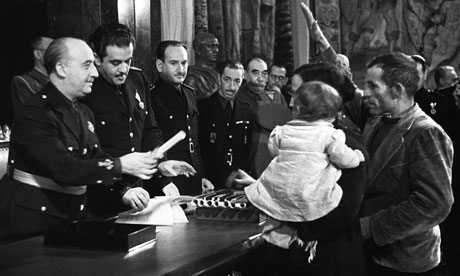
Spanish mother reunited with daughter she was told had died at birth


Spanish dictator General Francisco Franco (left) gives a certificate to a family in Madrid in 1942.

For many years, parents were awarded for having large families. Baby-stealing is alleged to have begun during Franco's long rule. Photograph: AP

A Spanish mother has been reunited with her daughter four decades after being told
the child had died at birth. It is the first proven case in a growing scandal over babies stolen
by Spanish hospital doctors and sold for adoption.
A DNA test proved the blood tie between the two women after the daughter hired private detectives to trace her biological mother.
"The adoption was legal, with her birth certificate saying she was 'adopted from an unknown mother'," Antonio Barroso, the head of an organisation investigating cases of missing babies, said.
The mother was left to mourn her baby after being told she had died at birth in a Barcelona clinic. "The doctors told her that her daughter had died. She even has the death certificate," Barroso said. "We went to a laboratory and the result left no doubt. It is only now that the girl has seen her own death certificate."
Barroso said mother and daughter – who have asked not to be named – were reunited in December and the case had since been passed on to the attorney general's office.
Another spokesman for the group, Juan Luis Moreno, told El Pais newspaper that the mother had always suspected her child had not really died, but hospital authorities in Barcelona had told her they would take charge of burying the baby.
Many of those now seeking lost babies are women who never saw their baby's corpse because hospitals said they would take charge of burial.
Barroso's organisation has asked the attorney general to investigate several hundred cases of illegal adoption.
The attorney general agreed to co-ordinate the different investigations that will be carried out by prosecutors at a provincial level.
Barroso said the case opened up the possibility that many children who were adopted in circumstances that may have seemed legal at the time were actually stolen.
These would be added to existing cases where adopted children were apparently registered as the biological children of their adoptive parents.
Barroso helped found the group after discovering that his own parents had paid an intermediary who produced children for adoption from a hospital in Zaragoza.
The cases go back many decades. Although they began during the dictatorship of General Francisco Franco, they seem to have carried on after his death in 1975. On Tuesday, the Catalan Republican Left party will ask Spain's parliament to aid those seeking lost children, with the creation of a DNA bank to help them.

RACE DOESNT MATTER ?

Katharine Birbalsingh

Katharine Birbalsingh is the teacher who exposed the failings of the comprehensive school system at the Conservative Party conference this year. Her speech can be seen here. She is now looking for a job. Katharine has been teaching in inner London for over a decade and loves children. This is a resurrection of her popular blog, To Miss with Love, where her name was Snuffy. Her book, also called To Miss with Love, comes out in April 2011. Follow @Miss_Snuffy on Twitter to see what Katharine's doing now. Katharine's personal website iswww.katharinebirbalsingh.com.

Michael Gove's adoption guidelines may not satisfy 'race oriented' social workers. But they'll do wonders for children

Ethnic minority children usually wait three times longer to be adopted than white children (Photo: GETTY)
Michael Gove is to unveil new adoption guidelines on Tuesday to say that race should not be a “deal-breaker” when adopting a child. In other words, white couples should be allowed to adopt black and ethnic minority children.
Until now, white couples have been unable to adopt British black or ethnic minority children, and have been forced to pay thousands of pounds abroad for the joy of adopting a child. Why? Because they’re white and there aren’t enough white babies to go round.
Social workers are so ‘race-oriented’ that when they receive an application they try to place a child with a family of the same heritage as that child. All I can say is thank goodness my parents were around when I was growing up. Otherwise I might have been in care forever. They would have had to find a mixed-race couple, one Indian, one black. I wonder if it would have been necessary for the Indian parent to be Indo-Caribbean? Or was it only race that mattered, allowing any citizen of India to have a go at raising me? I wonder if a Pakistani would have been allowed to adopt me?
It is completely absurd and yet this practice has been going on for years. As a result, ethnic minority children wait on average three times longer than white children to find a permanent home. And while they are in care, they wreak havoc on some poor school. Then we say it isn’t their fault: they’re in care. There are different rules at school for kids who are in care. They are given more leeway. They don’t get punished in the way that other kids are. And that, of course, just encourages them to misbehave all the more. I have seen a Head make a decision about a kid, and when realising the kid is in care, change his mind because he realises his hands are tied.
But the damage to schools and children doesn’t stop there. It has always been cool to be bad, and if one black kid is bad, then some of the other black kids will copy him. Even some white kids will too. So bad behaviour spreads. Then we turn around and say we’re trying to help these kids by ensuring that they’re with parents of matching racial background!
I presume the obsession with matching racial identity stems from the idea that ethnic children need to understand their position in the Western world as one of belonging to a minority group that is liable to face racism from time to time. But is it really impossible for a white family to understand this and pass their understanding to their adopted child? Surely the applicant’s capacity to give the child the right kind of love and support is what should be judged! After all, if this is a real issue, diversity training could be put to good use here.
The faster we get our ethnic kids out of care, the more likely they are to find harmony and love and the more likely they are to behave at school. This development in the adoption laws is a stroke of genius. Its results may take years to show, but its impact on schools will be immediate, not to mention how many children’s lives it will transform.
Once again, I look at what Michael Gove is doing for children and take my hat off to him. I clap my hands in glee and wonder how anyone could possibly take issue with this decision. But experience has taught me, where I see common sense and cause for jubilation, others see dark motives and corrupt intentions. I’m looking forward to what the opposition says about this one!